
Home » General Dentistry » The Role of X-Rays in General Dentistry: What Edmonton Patients Should Know
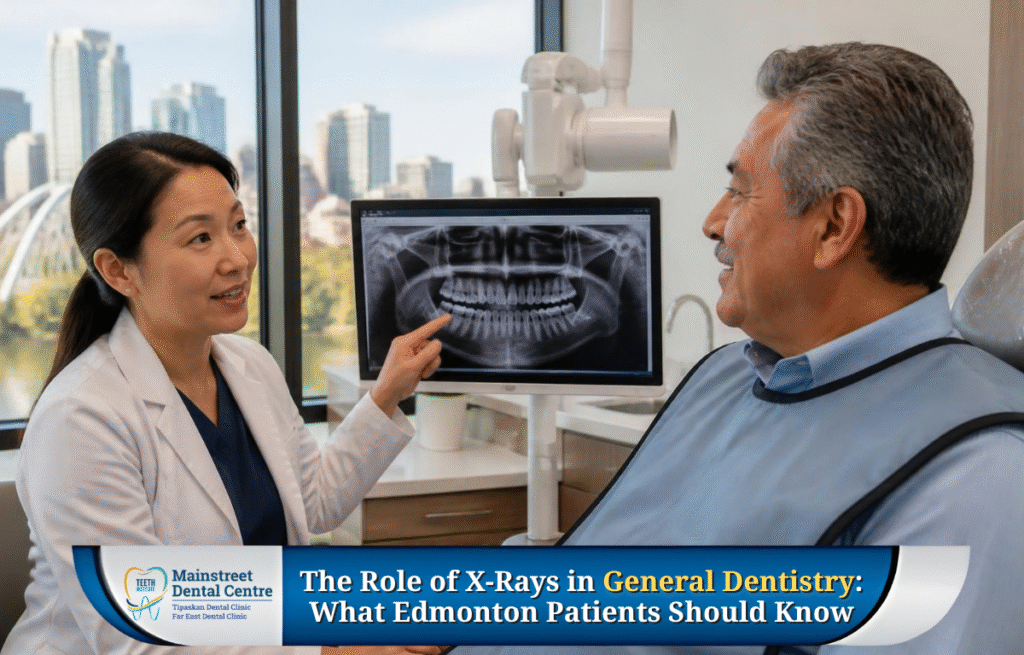
A dental examination involves more than looking at the teeth you can see in the mirror. Some dental problems develop beneath the surface or between teeth, where they may not be visible during a routine visual examination.
Dental X-rays give dentists a clearer view of areas that cannot always be examined directly. They can help identify certain dental problems early and provide additional information when planning treatment.
For patients receiving general dentistry in Edmonton, understanding why dental X-rays may be recommended can make routine dental visits easier and less confusing.
Dental X-rays, also called dental radiographs, are images that allow a dentist to examine structures inside and around the teeth that are not easily visible during a regular oral examination.
Depending on the type of X-ray, a dentist may be able to evaluate:
X-rays are not automatically required at every dental appointment. Your dentist determines whether imaging is appropriate based on your oral health, dental history, symptoms, age, risk factors, and the purpose of the examination.
A visual examination provides important information, but it does not show everything.
For example, a cavity between two teeth may not be easy to see during a visual examination. Similarly, changes around a tooth root or below the gumline may require additional imaging.
Dental X-rays can complement a clinical examination by giving your dentist information that may otherwise be difficult to obtain.
This makes them an important diagnostic tool in many areas of general dentistry in Edmonton.
For an overview of routine dental services, see general dental care in Edmonton.
One of the common reasons dentists may recommend dental X-rays is to look for decay in areas that are difficult to inspect directly.
Cavities can develop between neighbouring teeth, where a toothbrush may not reach effectively and where visual inspection can sometimes be limited.
Depending on the type of X-ray taken, imaging may help a dentist identify areas of decay that need further evaluation or treatment.
Early detection can be valuable because treating decay before it becomes more extensive may help preserve more healthy tooth structure.
Learn more about general dentistry and cavity prevention in Edmonton.
The visible portion of a tooth is only one part of its structure.
The roots extend below the gumline and are surrounded by bone and other supporting tissues. X-rays can help dentists examine these areas when there is a reason to do so.
This can be particularly useful when a patient has symptoms such as persistent tooth pain, sensitivity, swelling, or discomfort when biting.
If a deeper dental problem is suspected, imaging may provide information that helps the dentist determine the next appropriate step.
Dental infections can sometimes develop around the root of a tooth.
Patients may experience symptoms such as:
An X-ray may help a dentist evaluate the area around the affected tooth when an infection or other underlying problem is suspected.
If the inner portion of a tooth is affected, root canal treatment in Edmonton may be considered depending on the diagnosis.
Healthy teeth depend on the structures that support them.
Certain dental X-rays can provide information about the jawbone and supporting structures around the teeth. This can be useful when a dentist is evaluating periodontal concerns or changes in bone levels.
X-rays are not the only method used to evaluate gum health. Your dentist may also examine your gums directly and assess other clinical signs.
For patients concerned about gum health, gum disease treatment in Edmonton can provide more information about available care.
Dental X-rays can also help dentists plan certain treatments.
For example, imaging may be useful when evaluating:
Having a clearer picture of the underlying structures can help the dentist assess the condition of a tooth and determine which treatment options may be appropriate.
Not every dental problem is visible from the outside.
A patient may have persistent discomfort even when the tooth looks relatively normal. In these situations, a dentist may recommend an X-ray as part of a broader examination.
The image may help identify or rule out certain problems involving the tooth, roots, surrounding bone, or neighbouring structures.
However, an X-ray is only one part of the diagnostic process. Your dentist will consider your symptoms, dental history, clinical examination, and imaging together.
Patients who have fillings, crowns, bridges, implants, or other dental restorations may need periodic assessment of their oral health.
Depending on the situation, X-rays can provide information about areas around existing dental work that may not be easy to examine visually.
Regular examinations can help your dentist monitor your teeth and restorations over time.
Read more about the benefits of regular dental checkups in Edmonton.
No.
There is no universal rule that every patient needs an X-ray at every dental visit.
The frequency and type of dental imaging depend on individual circumstances.
Your dentist may consider factors such as:
A dentist should recommend imaging when the information it provides is relevant to your care.
Different dental X-rays provide different types of information.
Bitewing images are commonly used to examine the areas between teeth and can help identify certain types of tooth decay.
They can also provide information about the bone levels around the teeth.
These images show an entire tooth, including the crown and root, along with the surrounding area.
They may be useful when evaluating symptoms involving a particular tooth.
A panoramic X-ray provides a broader view of the teeth and jaws.
Depending on the clinical situation, it may be used to assess the overall dental structures or support treatment planning.
Additional forms of dental imaging may be recommended in specific circumstances. The appropriate type depends on what your dentist needs to evaluate.
Your dentist can explain why a particular image is being requested and what information it is expected to provide.
Dental X-ray technology uses radiation, so minimizing unnecessary exposure is an important part of responsible dental care.
Modern dental imaging systems can produce diagnostic images using relatively low levels of radiation. Dentists also follow established safety practices and only recommend X-rays when they are considered clinically appropriate.
If you have questions or concerns about radiation exposure, speak with your dental team before the imaging is taken.
The process is generally quick.
Depending on the type of image being taken, you may be asked to:
Some patients may find the sensor slightly uncomfortable, but the imaging itself is typically very brief.
Your dental team can explain what to expect before taking the image.
No.
X-rays are an additional diagnostic tool rather than a replacement for a clinical examination.
During a dental checkup, your dentist may assess your teeth, gums, bite, existing restorations, oral tissues, and other aspects of your oral health.
X-rays can then provide additional information about areas that cannot be evaluated completely through visual examination alone.
Combining clinical findings with appropriate imaging can give your dentist a more complete understanding of your oral health.
Some dental problems may cause few symptoms in their early stages.
By the time a patient experiences significant pain, a problem may already require more extensive treatment.
Appropriate dental examinations and imaging can help identify certain concerns earlier.
Early detection does not mean every dental problem can be prevented, but finding a problem sooner can give you and your dentist more opportunity to discuss treatment options.
This is one of the reasons preventive dental care in Edmonton remains an important part of maintaining long-term oral health.
Your dentist may consider an X-ray when there is a specific diagnostic reason.
For example, imaging may be recommended if you have:
The decision should be based on your individual dental needs rather than simply following a fixed schedule.
If you’re unsure why an X-ray has been recommended, it is perfectly reasonable to ask questions.
You can ask your dentist:
Why do I need this X-ray?
Understanding the purpose of the image can help you feel more comfortable with the recommendation.
What will the X-ray show?
Your dentist can explain which part of your teeth, jaw, or surrounding structures they need to evaluate.
Do I need this X-ray today?
If imaging is being recommended as part of a routine visit, you can ask how it fits into your current dental assessment.
Can you explain the results to me?
Your dentist can discuss what the image shows and whether any follow-up treatment is recommended.
A dental X-ray is not a diagnosis by itself. It is one piece of information that a dentist can use alongside your symptoms, medical and dental history, clinical examination, and other findings.
For Edmonton patients, this means a routine dental appointment may involve several different steps depending on your individual needs.
The goal is not simply to take an X-ray. The goal is to gather the information needed to understand your oral health and make appropriate treatment decisions.
There is no single schedule that applies to every patient. Your dentist determines when X-rays are appropriate based on factors such as your age, oral health, dental history, symptoms, and risk of dental disease.
Certain dental X-rays can help dentists identify decay, particularly in areas between teeth that may be difficult to examine visually.
The imaging procedure itself does not hurt. Some types of X-ray sensors may feel slightly uncomfortable in the mouth for a short time.
Dental X-rays involve radiation, so they should be used when clinically appropriate. Modern dental imaging uses relatively low radiation levels, and dental professionals follow safety procedures to limit unnecessary exposure.
Not necessarily, but the absence of pain does not always mean there are no dental problems. Your dentist may recommend imaging when there is a clinical reason to look for problems that may not be visible or causing symptoms.
Certain dental X-rays can provide information about the bone supporting the teeth, which can be useful when assessing periodontal health. However, dentists use clinical examination and other methods as part of a complete gum evaluation.
Certain X-rays can help a dentist evaluate areas around a tooth root when an infection or other underlying problem is suspected. Your symptoms and clinical examination are also important in making a diagnosis.
Yes. Always tell your dentist if you are pregnant or could be pregnant so your dental team can consider your individual circumstances when planning care and any necessary imaging.
Dental X-rays can provide valuable information that may not be available through a visual examination alone. When used appropriately, they can help dentists evaluate hidden areas, investigate symptoms, monitor certain conditions, and plan treatment.
However, X-rays are only one part of comprehensive dental care.
Regular dental examinations, professional cleanings, good oral hygiene, and prompt attention to dental symptoms all contribute to maintaining healthy teeth and gums.
If you have questions about whether you need dental X-rays or want to stay on top of your routine oral health, speaking with a dental professional is the best place to start.
Mainstreet Dental Clinic provides general and preventive dental care for patients in Edmonton.
Mainstreet Dental Clinic
6578 28 Ave NW, Edmonton, AB T6L 6N3
Phone: +1 (780) 461-3500
Email: Info@mainstreetdentalclinic.ca
Hours: Monday to Saturday, 9:30 AM to 5:30 PM
Call +1 (780) 461-3500 to schedule your dental appointment and discuss your dental X-ray or general dentistry needs with the Mainstreet Dental Clinic team.
Mainstreet Dental Clinic provides trusted, personalized dental care in Edmonton for children, families, and individuals. We offer general, cosmetic, restorative, pediatric, and emergency dental services.
© 2026 Mainstreet Dental Clinic – Smart Dentistry Needs Smart Design — Webital Technologies & Signages