Home » Restorative Dentistry » How Restorative Dentistry Can Repair and Protect Damaged Teeth in Edmonton
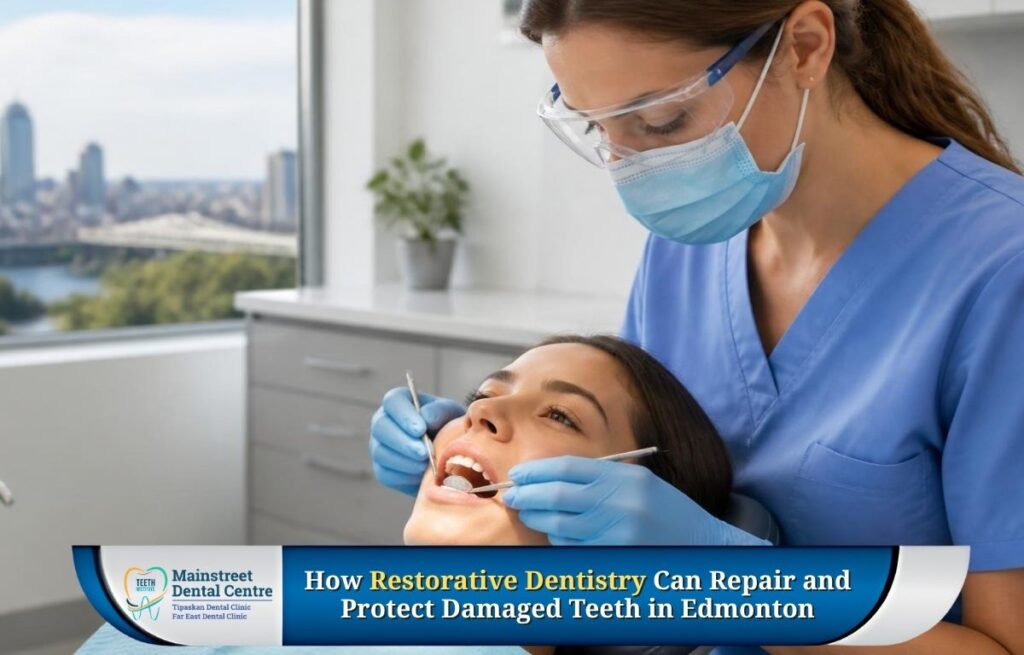
Damaged teeth can affect much more than the appearance of your smile. A cracked tooth may make chewing uncomfortable, while decay can gradually weaken a tooth and increase the risk of further damage. Missing teeth can also affect how you eat, speak, and feel about your smile.
The good news is that many dental problems can be repaired or managed with appropriate restorative treatment. Restorative dentistry in Edmonton focuses on repairing damaged teeth, restoring dental function, and protecting remaining tooth structure whenever possible.
If you are searching for a restorative dentist in Edmonton, understanding the available treatment options can help you know what to expect. Depending on the condition of your teeth, restorative care may include fillings, dental crowns, root canal treatment, bridges, dental implants, or other procedures.
At Mainstreet Dental Clinic, restorative treatment is based on the patient’s individual dental needs. A professional examination can help determine why a tooth is damaged and which treatment may be appropriate.
Restorative dentistry focuses on repairing or replacing teeth that have been affected by decay, injury, wear, infection, or tooth loss.
The purpose is not simply to improve how a tooth looks. Restorative treatment can also help restore important functions such as chewing and biting while helping protect the affected tooth and surrounding oral structures.
Depending on your condition, restorative care may involve:
The recommended treatment depends on factors such as the amount of remaining tooth structure, the location of the damage, gum health, and your overall dental condition.
For a broader overview, explore tooth replacement and restoration in Edmonton.
Teeth can become damaged for many different reasons. Some problems develop gradually, while others happen suddenly.
Common causes include:
Untreated cavities can gradually destroy tooth structure. In the early stages, decay may not cause noticeable symptoms.
As decay becomes more extensive, a tooth may become sensitive, painful, or structurally weak. Prompt dental care may help prevent the problem from becoming more complicated.
Teeth can crack because of an injury, biting hard foods, teeth grinding, or weakened tooth structure.
Not every crack is the same. Some may require minimal treatment, while deeper damage may need more extensive restorative care.
Falls, sports injuries, accidents, and other impacts can damage teeth.
A tooth may become chipped, cracked, displaced, or broken. Even if the injury does not cause immediate pain, a dental examination can help determine whether there is underlying damage.
Over time, teeth can become worn due to factors such as grinding, clenching, acidic foods and drinks, or other habits.
Significant wear can affect tooth structure and may change how your teeth come together.
Losing a tooth can affect chewing and may allow neighbouring teeth to move into the empty space.
Depending on your circumstances, a dentist may discuss different tooth replacement options.
Restorative treatment varies according to the type and severity of damage.
A minor cavity does not require the same treatment as a severely fractured tooth. Similarly, replacing a missing tooth involves a different approach from restoring a tooth that can still be preserved.
Here are some common restorative options.
Dental fillings are one of the most common restorative treatments.
If a tooth has a cavity, the damaged portion can be removed and the area restored with an appropriate filling material.
A filling can help restore the tooth’s shape and function while addressing the area affected by decay.
Treating cavities earlier can also reduce the chance of the damage progressing deeper into the tooth.
If you are concerned about tooth decay, our guide to preventing cavities with general dentistry in Edmonton provides additional information about prevention and routine dental care.
When a tooth has experienced substantial damage or has lost significant structure, a filling may not provide enough support.
In these situations, a dental crown may be recommended.
A crown covers the affected tooth and can help protect it while restoring its shape and function. Crowns may be considered for teeth affected by extensive decay, fractures, large fillings, or certain root canal treatments.
Your dentist will assess the tooth before recommending a crown.
Learn more about dental crowns in Edmonton and how they can be used as part of restorative dental care.
Some damaged teeth develop problems inside the tooth.
When decay, trauma, or another condition affects the inner portion of a tooth, root canal treatment may be recommended.
The procedure involves treating the affected tissue inside the tooth, cleaning the area, and sealing it. In suitable cases, this can allow the natural tooth to remain in place rather than being extracted.
Symptoms that may indicate the need for dental assessment include:
However, symptoms vary, and some dental infections may not initially cause obvious discomfort.
If you have been advised that you may need this treatment, read about root canal treatment in Edmonton.
A missing tooth can leave more than an empty space.
Depending on the situation, tooth loss can affect chewing and may contribute to changes in the position of nearby teeth.
A dental bridge can replace a missing tooth or teeth by using a supporting structure to hold the replacement tooth in place.
Whether a bridge is appropriate depends on the health of the surrounding teeth and your individual dental needs.
You can learn more about dental bridges in Edmonton and their role in tooth replacement.
Dental implants are another option for replacing missing teeth.
An implant is designed to provide a stable foundation for a replacement tooth. Implant treatment generally involves several stages, so your dentist will need to assess your oral health before determining whether this option is suitable.
Factors such as gum health, available bone, the location of the missing tooth, and your overall dental condition may be considered.
If you are considering implants, our guide to dental implants as a gold-standard tooth replacement provides more information.
In many cases, restorative treatment can help preserve a natural tooth. However, whether a tooth can be saved depends on the type and extent of damage.
Your dentist may evaluate:
A small cavity may require only a filling. A significantly weakened tooth may need a crown. If the inner portion of the tooth is affected, root canal treatment may be considered.
In some situations, a tooth may be too damaged to restore predictably. If that happens, your dentist can discuss extraction and replacement options.
Some dental problems are obvious, while others develop slowly.
You may benefit from a restorative dental assessment if you notice:
You do not always need to wait until a tooth becomes painful.
Routine examinations can help identify problems earlier. If you have noticed a change in your teeth, scheduling an assessment can help determine whether treatment is necessary.
For general preventive care, see preventive dental care in Edmonton.
It can be tempting to postpone treatment when a damaged tooth does not hurt.
However, the absence of pain does not necessarily mean that a tooth is healthy.
A cavity can become deeper. A crack can become more extensive. A damaged restoration can leave the underlying tooth vulnerable.
Early assessment gives your dentist an opportunity to evaluate the problem and explain your options.
Depending on the condition, treating a dental problem earlier may allow for a more straightforward restoration rather than waiting until the tooth requires more extensive treatment.
Healthy teeth play an important role in everyday activities.
When a tooth is damaged, you may unconsciously avoid chewing on one side of your mouth. A missing tooth can also make certain foods more difficult to eat.
Restorative treatment aims to address these functional concerns.
Depending on the treatment, restoring a damaged or missing tooth may help you:
Your dentist can explain which goals are realistic for your specific situation.
Restorative and cosmetic dentistry can sometimes overlap, but they have different primary goals.
Restorative dentistry generally focuses on repairing damaged teeth, restoring function, and replacing missing teeth.
Cosmetic dentistry primarily focuses on improving the appearance of the smile.
For example, a tooth-coloured filling can repair decay while also providing a natural-looking appearance. A crown can strengthen a damaged tooth while improving its visible shape.
If you are considering treatment for both functional and aesthetic concerns, understanding the difference can be helpful. Read restorative vs. cosmetic dentistry in Edmonton to learn more.
When you visit a restorative dentist in Edmonton, the first step is usually a comprehensive assessment.
Your dentist may ask about:
A clinical examination allows the dentist to assess the tooth and surrounding tissues.
Dental X-rays or other diagnostic imaging may also be recommended when appropriate. These tools can provide information about areas that cannot be fully assessed during a visual examination.
Once the cause and extent of the problem are understood, your dentist can explain the available treatment options.
It is completely reasonable to ask questions before starting dental treatment.
Consider asking:
Understanding the cause can help you make sense of the recommended treatment.
If a tooth is damaged, ask whether it can be restored and what factors affect that decision.
Depending on your condition, there may be more than one possible approach.
Your dentist can explain whether waiting may allow the problem to progress.
Good oral hygiene and regular dental visits can help you maintain both your restoration and remaining natural teeth.
Restorative treatment repairs or replaces damaged dental structures, but restored teeth still need ongoing care.
Helpful habits include:
Regular dental visits can also help your dentist monitor existing restorations.
For more information, read about regular dental checkups with a general dentist in Edmonton.
There is no single lifespan that applies to every dental restoration.
The durability of a restoration can depend on:
A restoration can also become worn or damaged over time.
Regular examinations allow your dentist to monitor existing dental work and identify changes that may require attention.
Our article about the long-term benefits of high-quality dental restorations provides additional information about maintaining restorative dental work.
Some damaged teeth require prompt attention.
Contact a dentist as soon as possible if you experience:
A dental emergency should not be ignored simply because the symptoms started recently.
For urgent situations, explore emergency dental care in Edmonton.
If a tooth has broken suddenly, our broken tooth emergency guide for Edmonton can also help you understand what to do next.
Choosing a dentist for restorative treatment is an important decision.
Consider a dental clinic that:
It is also helpful to choose a dental practice where you can continue receiving regular care after your restorative treatment.
Mainstreet Dental Clinic provides general, restorative, family, cosmetic, and emergency dental services for patients in Edmonton.
You can learn more about the clinic and its approach to patient care on the Mainstreet Dental Clinic About Us page.
Restorative dentistry can include treatments that repair damaged teeth or replace missing teeth. Common options include fillings, crowns, root canal treatment, bridges, and dental implants.
Consider seeing a restorative dentist if you have a damaged, broken, cracked, decayed, weakened, or missing tooth. Persistent sensitivity, pain when chewing, or problems with an existing restoration may also require an evaluation.
It depends on the location and severity of the crack. Some damaged teeth can be repaired with a filling or crown, while deeper damage may require root canal treatment or another approach.
Some severely damaged teeth can still be restored. The decision depends on the remaining tooth structure, the location of the damage, infection, gum health, and other clinical factors.
Yes. Dental crowns are commonly used to protect and restore teeth that have been significantly weakened or damaged.
Yes. Root canal treatment is commonly considered a restorative procedure because it can treat problems inside a damaged or infected tooth and may help preserve the natural tooth.
Yes. Depending on your individual needs, options may include dental bridges, dental implants, or other tooth replacement solutions.
Good oral hygiene, regular dental checkups, professional cleanings, avoiding excessive pressure on restored teeth, and following your dentist’s recommendations can help protect your restorations.
Damaged teeth do not always need to be removed. Depending on the condition of the tooth, restorative treatment may help repair damage, restore function, and protect the remaining natural tooth structure.
From fillings and crowns to root canal treatment, bridges, and dental implants, restorative dentistry in Edmonton offers different solutions for different dental concerns.
If you are experiencing tooth damage or have been told that you need restorative treatment, a professional evaluation can help you understand your options.
Mainstreet Dental Clinic provides personalized dental care based on each patient’s oral health needs.
Mainstreet Dental Clinic
6578 28 Ave NW, Edmonton, AB T6L 6N3
Phone: +1 (780) 461-3500
Email: Info@mainstreetdentalclinic.ca
Hours: Monday to Saturday, 9:30 AM to 5:30 PM
Call +1 (780) 461-3500 to schedule a consultation and discuss your tooth repair or restoration needs.
Mainstreet Dental Clinic provides trusted, personalized dental care in Edmonton for children, families, and individuals. We offer general, cosmetic, restorative, pediatric, and emergency dental services.
© 2026 Mainstreet Dental Clinic – Smart Dentistry Needs Smart Design — Webital Technologies & Signages